I have updated the OpenSeizureDetector Privacy Policy to Version 2.0 (February 2022). There are no significant changes to the draft that I published a few weeks ago, because I did not receive any adverse comments on it.
The purpose of the change is to recognise the new Data Sharing feature that will be included in V4.0 of OpenSeizureDetector.
The new Privacy policy is here: OpenSeizureDetector Privacy Policy V2.0 (February 2022). The Google Play Store listing has also been updated to refer to this new policy. Please let me know if you have any concerns over this.
I am having problems with the account creation part of the data sharing system – users who have tested it have found they can create an account but the email that the system generates for them to verify the account creation is not getting through. I am looking at options of how to fix this, and have listed four so far here: https://github.com/OpenSeizureDetector/webApi/issues/30
If anyone with more experience of server and database management than me has any good ideas, please let me know!
Thanks, Graham (graham@openseizuredetector.org.uk)
We have used the Data Sharing feature to analyse why OpenSeizureDetector did not detect a particular seizure event, and have found a solution…. so it is useful :).
Long Version:
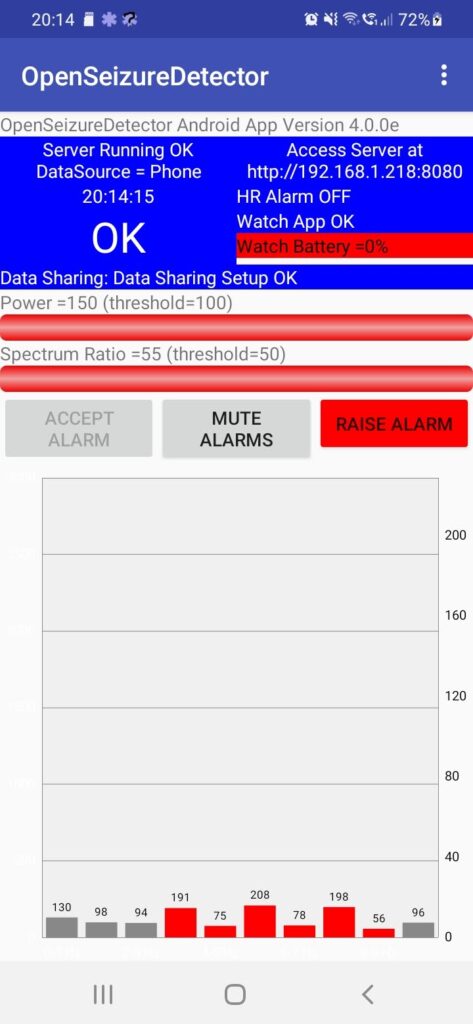
One morning last week Benjamin had a sort of partial seizure – it was not a full blown tonic-clonic seizure – he stayed sat up but his arms were a bit shaky and making a slow flapping motion with his hand too. The addition of the slow movement on top of the shaking meant it was going to be difficult for OpenSeizureDetector to pick it up (because it is tuned to detect shaking), but I was disappointed that it did not even give a warning.
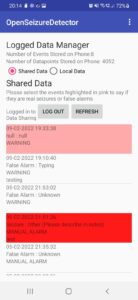
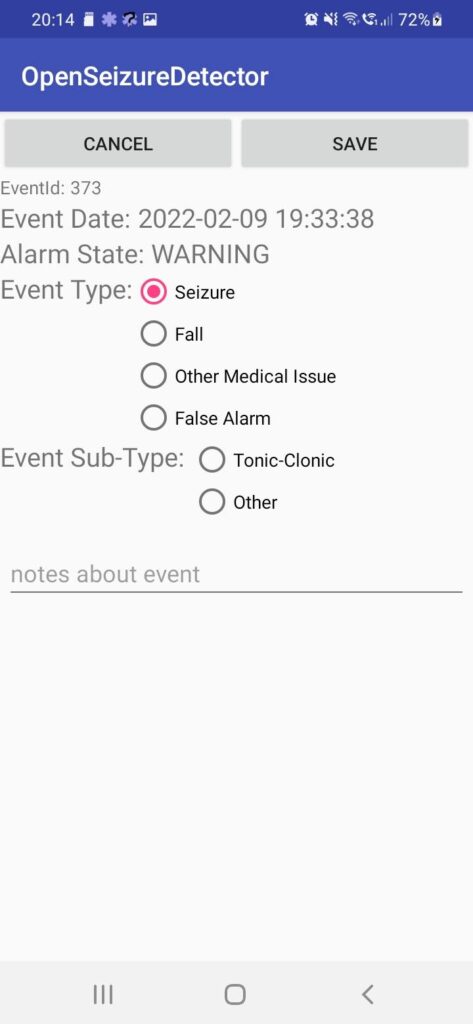
Fortunately I had upgraded our ‘production’ system to use the draft Version 4 of OSD with data sharing enabled, so when we noticed the seizure I pressed the ‘raise alarm’ button on the phone screen to record a seizure event manually. The data was saved to the database and I could mark it as a genuine seizure and at a short description.
We used a suggestion by Jamie Pordoy who is working on the system with me to take the saved data and feed it back into OpenSeizureDetector so I could see what it was doing during the seizure.
Running it through OpenSeizureDetector again meant I could see that during the seizure we did have several periods when the ‘spectrum ratio’ exceeded the set threshold of 50….but for some reason it did not alarm….this was wrong….
I delved through the code and realised that when I had converted the code from the Pebble Version to the Garmin one (or maybe when I tidied it up later)…I put a bracket in the wrong place. This meant that although we can specify the spectrum ratio threshold as single units (51, 52, 55 etc.) the way it was working was that if you set a threshold between 50 and 59, it would only alarm if the actual value exceeded 60. This is fine for full tonic-clonic seizures where I expect the ratio to be over 60, but not so good for less severe ones.
I have put a fix for this in Version 4 of OSD. This means you may initially see more false alarms with Version 4 than you do Version 3, so you may need to increase your Alarm Ratio Threshold a bit to get the same false alarm and detection performance.
It is good to start to see some use for all this ‘Boring Software Infrastructure’!
An example of the analysis of the stored seizure that we can now do easily is shown below
Graham.
The bottom graph shows the problem – the blue line is the ROI ratio with the horizontal line showing the set threshold for alarm. but the only alarm event was the manual alarm that I generated by pressing the ‘raise alarm’ button on the phone. I would have expected it to alarm between 0 and 25 seconds on the graph.
Thank you to those users who have offered to test the draft version 4 of OpenSeizureDetector. I have added some instructions on testing it to the web site here: https://www.openseizuredetector.org.uk/?page_id=1842If anyone else would like to try it, please do, and feed back your experiences (good and bad!). Graham Jones (graham@openseizuredetector.org.uk)
OpenSeizureDetector V4 is about ready for some limited user testing to check it is stable before I release it more widely.
The main change in V4 is the introduction of ‘Data Sharing’ where users (optionally) have the ability to share their data to a central database to allow us to build a large data set of normal activities that appear to be ‘seizure like’ and may cause false alarms, and most importantly real seizures for comparison.
It also introduces a some smaller changes:
check on whether the system is going to ‘optimise’ OpenSeizureDetector’s battery usage (by shutting it down!), and prompts the user to disable this feature to make sure OpenSeizureDetector works correclty.
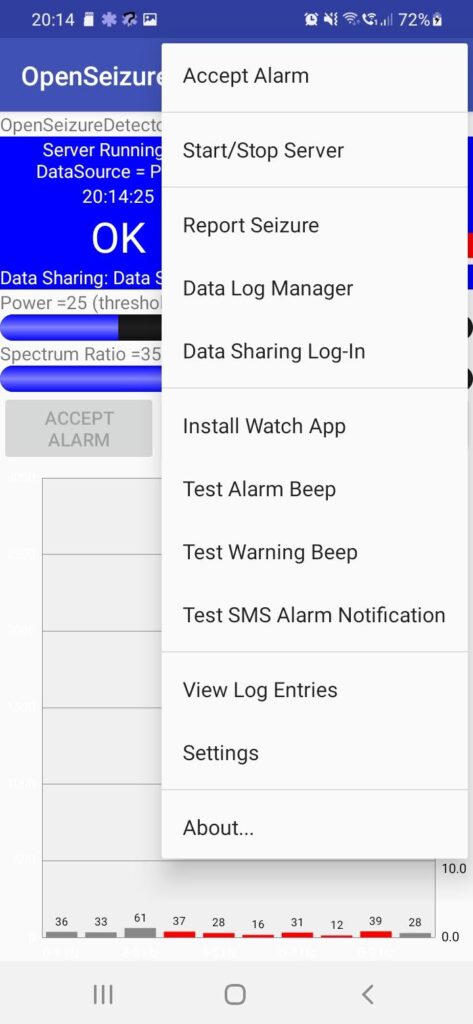
Adds a ‘Report Seizure’ button to record a seizure even if OpenSeizureDetector does not alarm automatically.
So from the user’s perspective the changes are not radical, but there is a lot of extra code to run the user interface for the data sharing (logging on, displaying data, editing), so I’d like a few people to make sure it is stable for them and does not crash before I publish it.
My idea is that as long as that testing is successful, then in a couple of weeks I will publish Version 4 on Google Play Store.
For this initial testing what I need users to do is:
Run through the registration, user verification and log-in process to the data sharing database.
Generate some events by doing seizure-like activities and using the ‘report seizure’ function.
Edit the events to mark them as either genuine seizures or false alarms.
Check that the system does not crash unexpectedly.
Please drop me an email if you are able to help with this initial testing.