Heart Rate Alarm Development

A query from a user has prompted me to look into the results from the Data Sharing Database of user-contributed data to see if we can make better use of the Heart Rate measurements on watches. We currently have a simple heart rate threshold alarm system which can be useful for night time monitoring, but is prone to alarm during normal daily activities when heart rate varies.

The analysis of the tonic-clonic seizure data in the database can be found here:

https://github.com/OpenSeizureDetector/Android_Pebble_SD/blob/V4.1.x/doc/Adaptive_Heart_Rate_Alarm__Assessment.pdf

We identify three different types of heart rate response to a seizure – High response, modest response and no response. Typical high and modest response heart rate plots are shown below:

The conclusion is that for some people the heart rate increases significantly enough during a seizure that an ‘adaptive threshold’ technique can give a useful additional seizure detection method in addition to motion detection. Other users though do not see a significant enough change in heart rate that if we were to set the parameters sensitive enough to detect the observed changes, we would see lots of false alarms.

We will implement this adaptive threshold heart rate algorithm into the next release of OpenSeizureDetector, as it may benefit some users.

Any comments or questions, please contact graham@openseizuredetector.org.uk

OpenSeizureDetector Reliability

Our son, Benjamin had his first ‘big’ tonic-clonic seizue for some time this morning. This was the sort that needs a few hours rest to recover afterwards – the ones he has had more recently have been smaller and he has recovered quickly.

The main OpenSeizureDetector algorithm detected it well – it woke us up just before 0400 and although I could not see any movement on his video monitor, he was having a seizure when we went to check on him – so OpenSeizureDetector did exactly what it was designed to do, which is good.

I was also running the beta test of the ‘Artificial Intelligence’ (Machine Learning) algorithm, but this did NOT detect the seizure – this is a sign that we do not have enough of these more severe seizures on the Data Sharing database to train it properly (it detects the smaller seizures well though).

I will add the data from this new seizure into the training process and see if we can get it detecting it without increasing the false alarm rate significantly.

So, if you are using the Beta test version of OpenSeizureDetector (V4.1.x), please DO NOT disable the original OpenSeizureDetector algorithm because although the machine learning version will reduce the false alarm rate significantly, I am not confident that it will detect the larger, more severe tonic-clonic seizures at the moment. This does not affect the default OpenSeizureDetector algorithm which detected this seizure very well, so should continue to be used.

The graph below shows the original algorithm going onto an ALARM state (alarmState=2) soon after the start of the seizure and generating a lot of alarms during it, which is the correct response.

OSD Algorithm Performance during ‘large’ tonic clonic seizure (Alarm State=2 is a full alarm condition)

Any questions, please let me know.

Graham (graham@openseizuredetector.org.uk).

Fixed Text Overlapping Issue on Garmin Watches

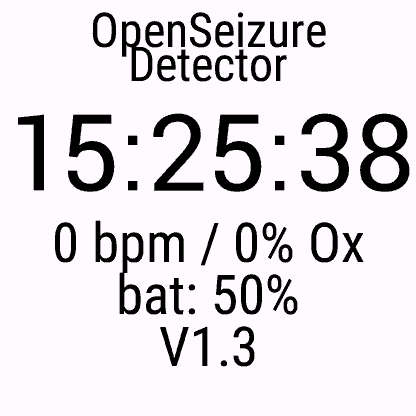
There was an issue with the newer, higher resolution watches (such as Venu 2) which meant that the text rows overlapped.

This is now fixed in V1.3 of the GarminSD watch app, which is available from Github here: https://github.com/OpenSeizureDetector/Garmin_SD/releases/tag/V1.3

Please let me know if there are any issues with this version, and whether it has fixed the issues that you reported on the newer devices.

Thanks,

Graham (graham@openseizuredetector.org.uk)