
Thank you to everyone who has signed up to our Data Sharing programme to contribute to the anonymous Open Seizure Database. Version 1.10 of the database is now available for research under our licence (which requires that the research is published so that the OpenSeizureDetector project has the opportunity to benefit from the research).
We now have over 250 seizure events recorded in the database, and I have been working on a Machine Learning algorithm using it, which I hope to incorporate into the next release of the OpenSeizureDetector app in a few weeks.
The database is however dominated by three major contributors as you can see from the graph below.
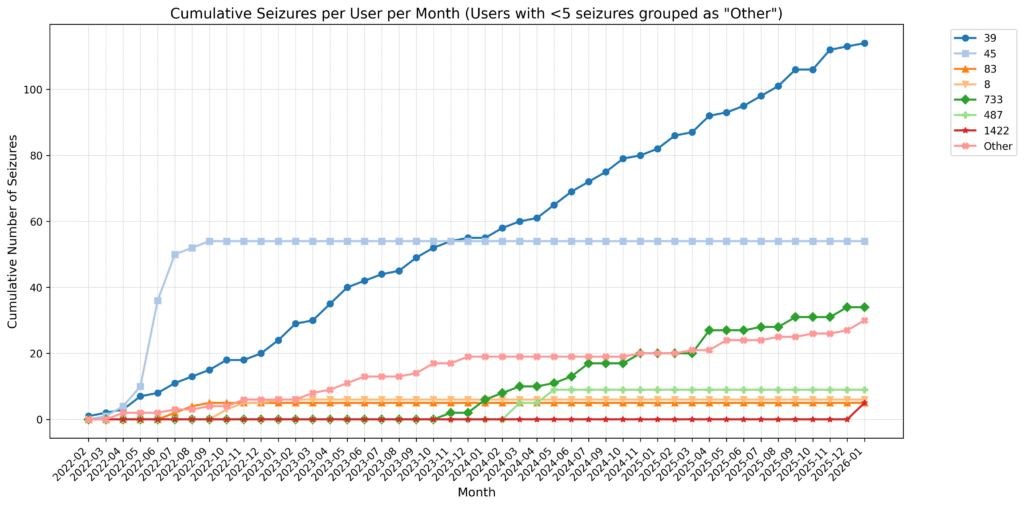
It would be best to have seizures from as wide a variety of people as possible to make sure that the model we produce using the data is as general as possible and will work for people who do not have data in the database.
So if you or someone you know has regular seizures, please consider wearing a watch and running OpenSeizureDetector to contribute to the database – you only need a PineTime watch to be able to contribute, so the cost is low.
If you are interested in carrying out research into seizure detection using the database, please get in touch and we can give you access to the data (osdb@openseizuredetector.org.uk or graham@openseizuredetector.org.uk).
Thanks!
Graham.