A new version (V4.1.2) of OpenSeizureDetector will be available for Beta testers shortly.
The main change is that it upgrades the Artificial Intelligence (Machine Learning) seizure detection algorithm to V0.24. This version has been trained using data provided by users using the Data Sharing system and a set of ‘Normal Daily Activity’ data that we have collected in order to reduce false alarms.
The calculated performance of the new model is a seizure detection reliability of 88% with very few false alarms generated from normal daily activities – it will require further testing to check the true false alarm rate though. Technical Details are available on the OpenSeizureDatabase Github Repository.
If we can validate that the performance is as good as indicated above, this will be a very large improvement in the performance of OpenSeizureDetector.
V4.1.2 also introduces a ‘Normal Daily Activity’ (NDA) Logging feature that allows users to record all of their data to the Data Sharing systems to build up the best possible database of normal (non-seizure) activities.
If you would like to try this version of OpenSeizureDetector, please subscribe as a Beta tester here: https://play.google.com/apps/testing/uk.org.openseizuredetector.
Thanks, Graham (graham@openseizuredetector.org.uk)
Version 4.1.0 of the OpenSeizureDetector Android App is now live on Google Play store for people who have signed up to be Beta Testers.
The main change is the introduction of a Machine Learning (Artificial Intelligence) seizure detection algorithm (“CNN”). This appears to give better seizure detection performance and lower false alarm rate than the original OpenSeizureDetector Algorithm – but needs real-world testing to be sure about false alarms, and also to check that it runs ok on a variety of devices.
By default it is set to run both the original OpenSeizureDetector algorithm and the Machine Learning one – this will give the best seizure detection reliability but will not improve false alarms, as an alarm can be generated from either algorithm.
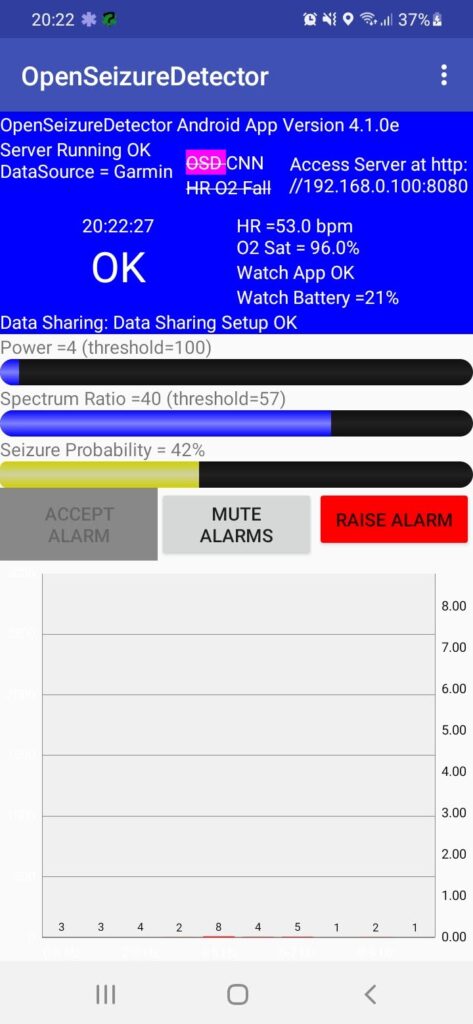
On the main screen you can see a list of the available algorithms – the ones which are not enabled will be crossed out to make it clear which ones are in use and which ones are not. This version also adds an additional menu item to the Data Sharing screen to allow you to mark all unverified events as False Alarms – please only use this if you are confident that you have not had any seizures, otherwise it will reduce the reliability of future versions as we develop the Machine Learning algorithm.
I would be grateful if users register and beta testers and try installing this version and report back on your experiences, before I make it available to everyone.
Thanks to those users who have been contributing to the Data Sharing system, we have been able to develop a Machine Learning (Artificial Intelligence) based seizure detector and incorporate it into OpenSeizureDetector.
This system uses a Convolutional Neural Network (CNN) which has been trained on data provided by users that has been reported as either a genuine seizure or a false alarm. The system uses 5 seconds of accelerometer data the same as the original Seizure Detection Algorithm and calculates a probability of the data representing seizure movements. It generates warnings and alarms if the calculated probability is over 50%.
The test results of the new system are surprisingly good – it will generate alarms for 94% of the 86 seizures reported by users since we introduced the Data Sharing system (compared to 72% for the original OpenSeizureDetector algorithm). The effect on false alarm rate is more difficult to determine from the available data, but it appears to reduce false alarms by a factor of between 4 and 5. We need more real-world use of the new system to be able to really assess the false alarm rate.
We will produce a technical write-up of the system performance and test results (see here for my current notes) , but the increase in seizure detection reliability was so significant that I thought I should make this available to users early.
Does it work? One concern with these Machine Learning / Artificial Intelligence systems is always that it has been taught to recognise very specific activities as seizures, but may not detect other slightly different ones. We have tried to address this by only using 75% of the available data for training the model, and keeping back 25% (=21 seizure events) purely for testing. Therefore the achieved overall 94% detection reliability means that the system detected most of the test seizures which were not used at all in training, which gives confidence that it will work for future seizures that it has not seen before.
By default both this new CNN algorithm and the original OpenSeizureDetector algorithm are enabled by in Verson 4.1.x of the OpenSeizureDetector Android App. This is awaiting approval by Google and will then become available to users who have registered as Beta testers on Google Play Store.
At the moment I would recommend that users use both algorithms, which will increase the seizure detection reliability, but not give any improvement in false alarms (because the original algorithm will still generate alarms). But please subscribe to the Data Sharing system and mark all false alarms – this will allow us to re-train the model to reduce its false alarm rate in the future.
The main change users will see is the main app screen now contains a central section showing which agorithms are enabled (OSD, CNN, HR, O2, Fall – for the Original OpenSeizureDetector Algorithm, the new CNN Machine Learning algorithm, Heart Rate alarm, Oxygen Saturation alarm and Fall detection). There is a third horizontal bar graph which shows the calculated seizure probability – see image below.
I would be grateful if those users registered as beta testers install this version when it becomes available and feed back any issues they have. Thank you again to those users who have contributed data that have made it possible to develop this improved seizure detection system.
Graham (graham@openseizuredetector.org.uk)
The main app screen, with new central section showing which algorithms are enabled, and a third horizontal bar graph for calculated seizure probability.