New Test Version Available (V5.0.0g)

A new draft of the Version 5.0 release (V5.0.0g) is now available for testers (you need to ask for access to this at the moment, because it is not quite ready for ‘production’ use).

The changes in this draft are:

  • Fixed an issue with the user interface not correctly showing ‘FAULT’ if the watch is out of range, and continuing to emit alarm sounds if it was in alarm when the watch went out of range.
  • Fixed a problem with the app using a lot of data storage on the phone.
  • Tidied up the graphs of battery level, heart rate etc.

Thank you for the testers for helping to identify these issues so we can fix them before we make this version generally available.

Note that the reason for producing this new version is to allow us to use the new Machine Learning (“AI”) seizure detection algorithm that has been devloped from user contributed seizure data. The intention of the Machine Learning (“AI”) algorithm is that it should give better seizure detection performance with fewer false alarms than the current OpenSeizureDetector algorithm. If you would like to help test the app before we make it available to all users, please email graham@openseizuredetector.org.uk with your google email address – then I can add you so that Google Play Store will give you the test version of the app.

Thanks

Graham.

New Test Version Available (V5.0.0f)

A new draft of the Version 5.0 release (V5.0.0f) is now available for testers (you need to ask for access to this at the moment, because it is not quite ready for ‘production’ use.

The changes in this draft are:

  • Fixed an issue with the whole system crashing on older android devices when the machine learning model is activated – it should now warn you that the model is not compatible with your hardware rather than crashing.
  • Improved the Network Data Source (which is used to give remote alarm notifications using your local wifi network) so that you can see the results of the machine learning algorithms on the remote devices.

The intention of the Machine Learning (“AI”) algorithm is that it should give better seizure detection performance with fewer false alarms than the current OpenSeizureDetector algorithm. If you would like to help test the app before we make it available to all users, please email graham@openseizuredetector.org.uk with your google email address – then I can add you so that Google Play Store will give you the test version of the app.

Thanks

Graham.

New Version of Android App: Testers Wanted

Thanks to everyone who has contributed to our Data Sharing programme, we now have enough seizure data to start developing a Machine Learning (‘AI’) model to replace the deterministic seizure detection algorithm that OpenSeizureDetector uses.

We now have a model that has slightly better seizure detection reliability and improved false alarm performance, compared to the original algorithm, so is good enough to deploy for real seizure detection use (I’ll do a separate technical post about this later).

To implement this model, we need an update to the Android App. I am calling the updated version Version 5, because there are some very significant changes that I have made to it at the same time. The changes include:

  • User Interface:
    • A new setup ‘wizard’ to guide new users through setting up the system – particularly for PineTime watches.
    • Simplified the settings screens.
    • Simplified the user interface and updated it to use modern ‘Material Design’ standards.
    • Seizure Detection:
    • The ability to download multiple Machine Learning (ML) models and combine the results for seizure detection, and prompt the user if a new recommended model is available for download.
    • Option to have the enabled seizure detection algorithms vote to decide whether to raise an alarm or not, to improve performance compared to a single algorithm.
    • Behind the Scenes
    • Improved reliability of data sharing reconnection and app startup/shutdown.
    • Split the code into various directories to make it clearer what does what.
    • Implemented a lot of the code modernisation proposals from user @AroonPro.

Testers Needed

There have been a lot of changes in this version of the app, so it needs a period of testing before we publish it as the main version on Google Play Store. There are three aspects to the testing:

  • User Interface / User Experience: Does the user interface make sense? Does the initial setup ‘wizard’ work for different data sources and algorithms? What would make it more intuitive for new users?
  • Functionality: Check that all of the functionality that you use in the current version still works the same (e.g. Mute function, SMS alerts, data sharing)
  • Seizure Detection Reliability: I will re-run the automated tests using the seizures in the OpenSeizureDatabase (Data sharing database) to check that the app is performing as expected (the original OSD algorithm works as the previous version, and the new Machine Learning algorithm performs as well as it did on the computer version).

    If you would like to help with testing, please email graham@openseizuredetector.org.uk and we will work out a plan of how to do it.

A Few Screenshots below:

First-Run setup ‘wizard’ welcome screen
Data Source selection screen
PineTime watch configuration screen
Seizure Detection Algorithm Selection Screen
Example of the main screen showing the Machine Learning Algorithm in alarm.

Release of V1.10 of the Open Seizure Database

Thank you to everyone who has signed up to our Data Sharing programme to contribute to the anonymous Open Seizure Database. Version 1.10 of the database is now available for research under our licence (which requires that the research is published so that the OpenSeizureDetector project has the opportunity to benefit from the research).

We now have over 250 seizure events recorded in the database, and I have been working on a Machine Learning algorithm using it, which I hope to incorporate into the next release of the OpenSeizureDetector app in a few weeks.

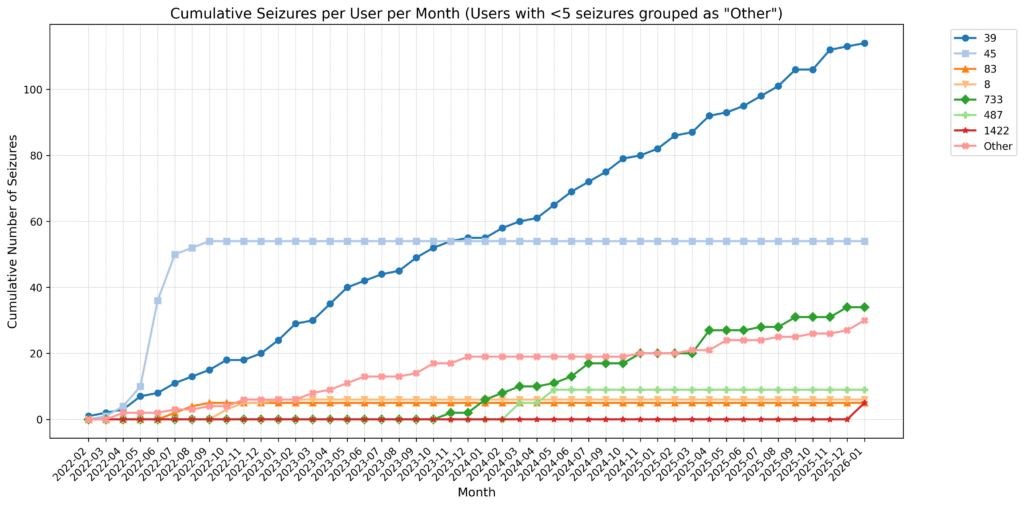
The database is however dominated by three major contributors as you can see from the graph below.

It would be best to have seizures from as wide a variety of people as possible to make sure that the model we produce using the data is as general as possible and will work for people who do not have data in the database.

So if you or someone you know has regular seizures, please consider wearing a watch and running OpenSeizureDetector to contribute to the database – you only need a PineTime watch to be able to contribute, so the cost is low.

If you are interested in carrying out research into seizure detection using the database, please get in touch and we can give you access to the data (osdb@openseizuredetector.org.uk or graham@openseizuredetector.org.uk).

Thanks!

Graham.

Progress with Machine Learning (AI) Seizure Detection Algorithm

I have spent some time over the Christmas break using the data that users have contributed via our Data Sharing (the Open Seizure Database) system.
It looks like I have a model for a single user which detects seizures better than our deterministic algorithm and has a much lower (4.7x) false alarm rate, which is what I was hoping to achieve with a Machine Learning model.

There is a very technical description of the progress for those who are interested here: https://github.com/OpenSeizureDetector/OpenSeizureDatabase/blob/main/Publications/User_Specific_Training_Report_1A.pdf

The next steps are to update the Android App so that it can download different models from our web site and publish that for beta testing.

I will then test the new model to make sure that we have not introduced a lot of other possible false alarm initiators before I train and test it against the whole Open Seizure Database. If that is testing I will make the new version of the app and this model available for all users for testing to see how it performs in the real world.

Graham
(graham@openseizuredetector.org.uk)

Simplified PineTime Installation Method

The method of installing the OpenSeizureDetector software on the low-cost PineTime watch is a bit convoluted, requiring the user to download a file from the OpenSeizureDetector web site, then use a third party app to flash the firmware onto the watch.
To Simplify this we have made an OSD Firmware Updater app which simplifies the process – with this app, it presents a list of available firmwares, highlighting the recommended one for installation, then downloads it and flashes it onto the watch.
There is a little video demonstration here:

The app is available for beta testing at the moment, so you need to sign up to access it off play store. To access it use one of the links below:

From an Android Device: https://play.google.com/store/apps/details?id=uk.org.openseizuredetector.pinetime

From a Web Browser: https://play.google.com/apps/testing/uk.org.openseizuredetector.pinetime

I will make it generally available and update the instructions as long as we do not find any major issues with it over the weekend.

Please let me know if you have any questions or issues with it.

Graham (graham@openseizuredetector.org.uk)

Volunteers Needed for Student Project

Teun van Kessel, a student from the AUAS university in Amsterdam, is looking to improve the user interface and user experience of the Open Seizure Detector app as part of his graduation project.

As part of his project, he would like to speak with a few users to learn about your experiences with setting up and using the app.

If you’re interested in helping, please contact Teun at hvateun@gmail.com

Thanks!

Graham (graham@openseizuredetector.org.uk)

Data Sharing System Maintenance

Update 20/09/2025 22:05 BST: The server change has gone pretty well – I now have automatic verification and password reset emails working, as well as normal user access, so the system should now behave the same as it did previously. Note that you might see some osdapi.org.uk domain names rather than osdapi.ddns.net, because I intend to phase out the .ddns.net domain. Please let me know if you find any problems with the new server – I will give it a few days before I switch off the old one in case we need to revert back to it. Graham.

Update 20/09/2025 19:10 BST: I think the new server is up and working for existing users – you should be able to see your existing data and upload new events. It went better than I had hoped :). I am having some trouble with registering new users because of problems sending confirmation emails, so I might end up re-starting the system a few times while I work out what is wrong. Graham.

The Data Sharing (Open Seizure Database) online system will be down for maintenance from this evening (Sat 20 Sept) until tomorrow (Sunday) evening (or maybe less….)

I am moving the system to a different server and will migrate all user data and login credentials etc. Users should not see any difference when it is back running but what could happen is:

  • The app might not start uploading data even though the system is live again – stopping and restarting the OpenSeizureDetector phone app should fix this.
  • You might have to log out and back in again on the Data Sharing screen (from my testing I do not think this is required, but you never know…..

You will not lose any data, because it is stored on the phone for 7 days, even if it is not uploaded to the system, and if it all goes wrong, I’ll reinstate the old server on Sunday evening.

I will update this post once I think the system is working again, so please let me know if you have any problems after that.

Thanks

Graham (graham@openseizuredetector.org.uk)

Release of V1.9 of the Open Seizure Database

Thank you to everyone who is taking part in our Data Sharing (the Open Seizure Database) programme. We now have data from 234 real seizures contributed by users to use to improve Open Seizure Detector.

Real seizure data is very important if we are going to improve OpenSeizureDetector to keep the current very good seizure detection reliability and improve the false alarm rate that we currently see. So please, if you have not signed up to the Data Sharing programme, please consider it (especially if you have regular seizures to help increase the size of the database).

Version 1.9 of the Open Seizure Database is now available for developers or researchers to use to investigate seizure detection methods.

If you would like access to the data to use for research, it is available under a straightforward Licence, so if you get in touch confirming you will agree to the terms of the licence, we will give you access to the full database.

Thanks again to everyone who has contributed data!

Graham (graham@openseizuredetector.org.uk)

Release of V4.3 of OpenSeizureDetector on Google Play Store

Version 4.3.x of the OpenSeizureDetector Android App is now available for all users on the Google Play Store. The two changes are:

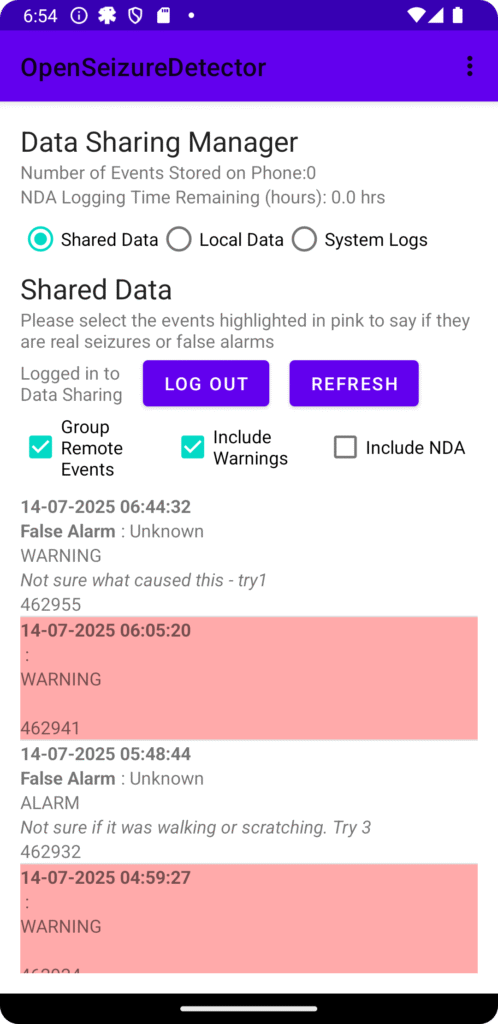
  • Improvements to the ‘Data Sharing’ screen so that events are grouped so that all events within a 3 minute period are treated as a single event, so you only have to edit it once (the other events in the group are updated with the same information when you edit it). The idea of this is to make reporting seizures easier as you only need to edit one event rather than every alarm and warning during the seizure.
  • Updated to target Android 15 (this is a requirement of Google Play Store). I think it is working ok, but some of the screen layouts seem to have changed a bit.

Please report any issues on our bug tracker at https://github.com/OpenSeizureDetector/Android_Pebble_SD/issues or email graham@openseizuredetector.org.uk.

Thanks

Graham (graham@openseizuredetector.org.uk)