SMS Alert Delay (V4.2.11)

A user requested the ability to change the delay between an alarm being generated and an SMS alert being sent, so they have more chance to cancel a false alarm before it is sent.

V4.2.11 includes this feature and will be available for beta testers to try once I have managed to get it through Google Review (there are quite a few admin changes because we need to target Android V14 now for Play Store…). If you would like to try it before it is on Play Store the installation .apk file is available on our source code repository here: https://github.com/OpenSeizureDetector/Android_Pebble_SD/blob/beta/releases/app-release-4.2.11b.apk

Please let me know if you find any issues with this version.

Graham (graham@openseizuredetector.org.uk)

V2.0.7 of the Garmin Watch App available for testing

A user reported that the Vivoactive 5 watch was suffering IQ! system crashes every few minutes. We traced this to being caused by the watch not sending the expected amount of data to the OSD app at some updates.

V2.0.7 introduces a check that we have received the expected amount of data, and if not, assumes that it is corrupt and sets it to zero. This does not appear to cause any problems on other devices, but I would appreciate it if Garmin users would try this version and let me know if they see any difference compared to V2.0.6.

(It would be good to try this on a VenuSQ watch too to see if this might be the cause of the strange behaviour on those devices).
The app .prg file is available on our Github repository: https://github.com/OpenSeizureDetector/Garmin_SD/releases/tag/v2.0.7

Thanks to Pierre for implementing this change very quickly when it was reported last week!

Graham (graham@openseizuredetector.org.uk)

Release of OpenSeizureDatabase V1.5

Version 1.5 of the Open Seizure Database is now available for researchers to help develop improved seizure detection algorithms which can be incorporated into OpenSeizureDetector.

Thank you to everyone who has contributed seizure data to the database – we are building up a very useful database of data for various types of seizure from tonic-clonic to atonic seizures.

If anyone would like access to the database for research purposes, please see the licence requirements, and contact osdb@opensezuredetector.org.uk.

Thanks, Graham (graham@openseizuredetector.org.uk)

Data Sharing System Problem

There seems to be a problem with the Data Sharing system at the moment – I am getting an error when retrieving data from the server in the Android App.

I am going to work today, so will look at fixing it tonight (UK time).

Graham (graham@openseizuredetector.org.uk)

Seizure Detection Algorithm Development

I have been doing some work to extend the seizure detection algorithm to detect seizures that have more of a ‘flapping’ motion than the shaking associated with a tonic-clonic seizure, by analysing some of the data in our Data Sharing database.
There is a rather technical discussion in the page below for anyone who is interested: https://openseizuredetector.github.io/pages-developer/flap-detector.html

Please get in touch if you have any thoughts or suggestions for this approach.

graham@openseizuredetector.org.uk

V4.2.10 Available for Beta Testers

V4.2.10 should be available for beta testers on play store shortly (once review by Google is complete).

This is a minor bug fix issue that addresses three user reported issues with V4.2.8 – Thank you for reporting any issues you find!

Regards
Graham (graham@openseizuredetector.org.uk)

Important Information for PineTime Users

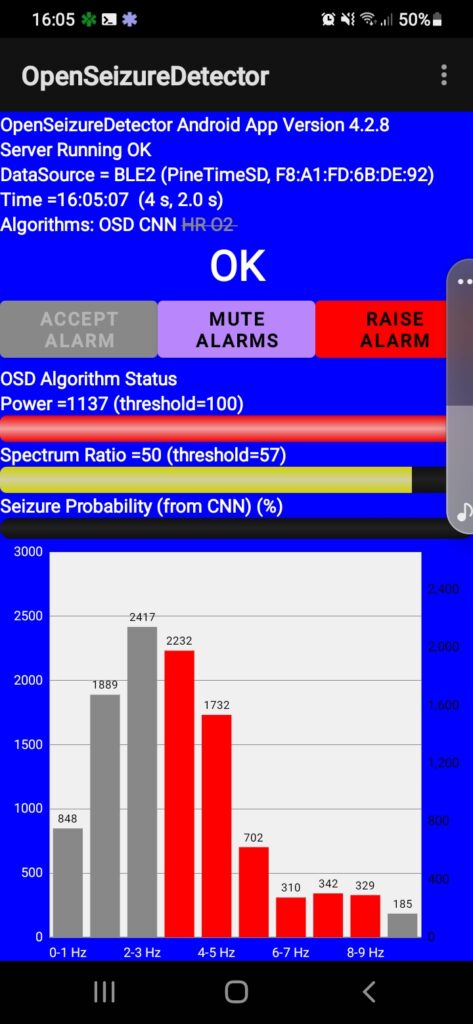
Summary: If you are testing PineTime, I recommend that you change the Alarm Frequency Min setting from 3 Hz to 2Hz, and reduce the Alarm Ratio Threshold from 57 to 50. This does not affect Garmin watches.

We have been using PineTime in our ‘Production’ OpenSeizureDetector set-up for a few weeks now (after several months of off-line testing).

I had noticed that we were getting fewer false alarms with PineTime than we had been with Garmin, but our false alarm rate does vary depending on Benjamin’s behaviour.

However this morning he head a tonic-clonic seizure which I would have expected OpenSeizureDetector to detect, but it did not alarm, so I have been looking into the reasons.

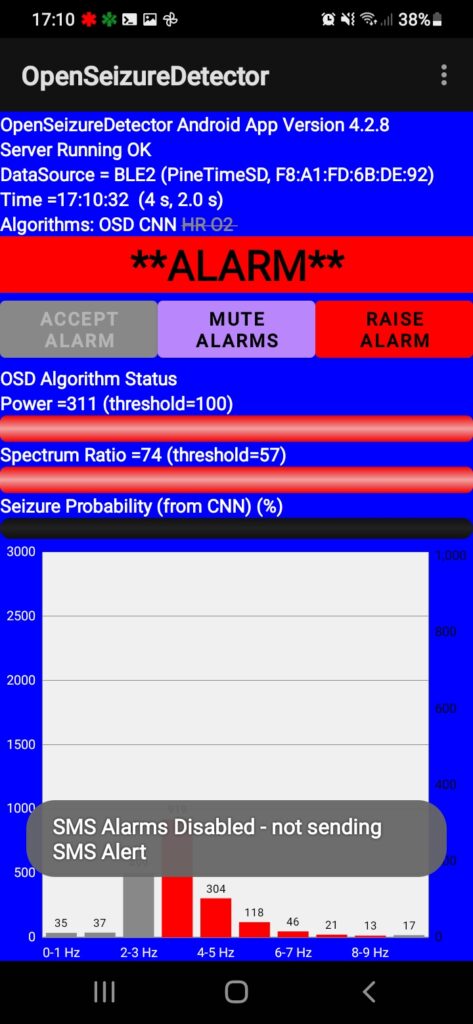
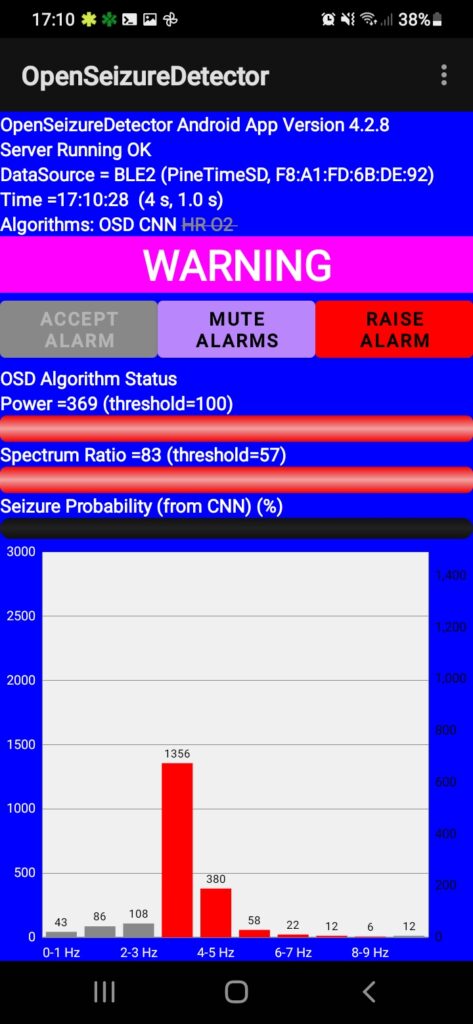
It seems that the detected frequency of movement was slightly lower than I would have expected, more like 2 Hz rather than 3 Hz, so it was out of the detection range of the default settings. To address this, I have made the following changes to our settings:

  • Alarm Frequency Min: Changed to 2 Hz from the default 3 Hz.
  • Alarm Ratio Threshold: Changed to 50 from the default 57

I have ran these changes through the database of seizure data, and it does increase the detection reliability as we would expect. It is also giving more false alarms on the Normal Daily Activity database, but I do not know yet how significant this will be in practice – I will update this once we have tried these settings for a bit longer.

In the interim, I recommend that PineTime users change the Alarm Frequency Min setting from 3 Hz to 2Hz, and reduce the Alarm Ratio Threshold from 57 to 50. This does not affect Garmin watches.

I will investigate the PineTime performance more closely to see if it is a sampling rate issue compared to Garmin, so this might involve a change to the PineTime firmware to fix it.

Release of V4.2 of OpenSeizureDetector

Version 4.2 of the OpenSeizureDetector Android App is now available on Google Play Store. The main changes introduced in this version are:

  • Introduces support for V2.0 and higher of the Garmin Watch App, which has reduced battery consumption, thanks to the work of Pierre Bonneau.
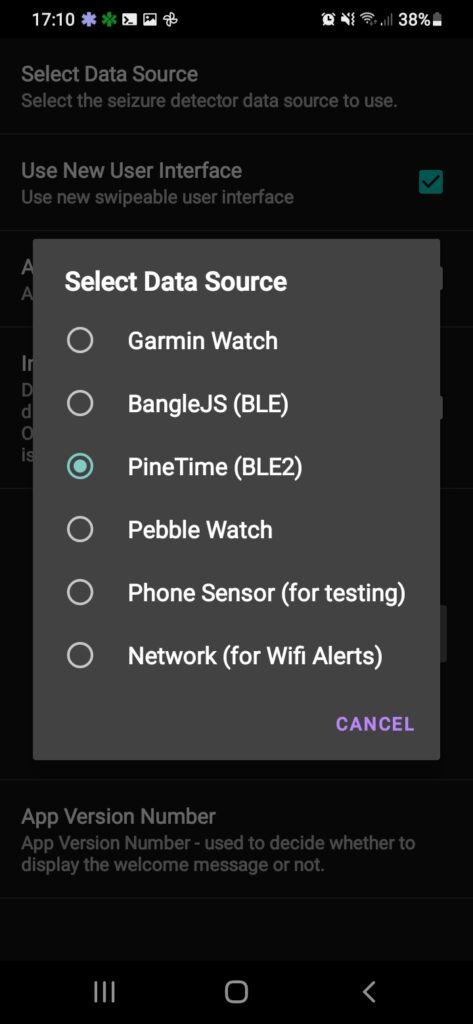
  • Introduces support for lower cost PineTime and BangleJS watches as an alternative to Garmin.
  • Fixed problem with notifications in Android 13
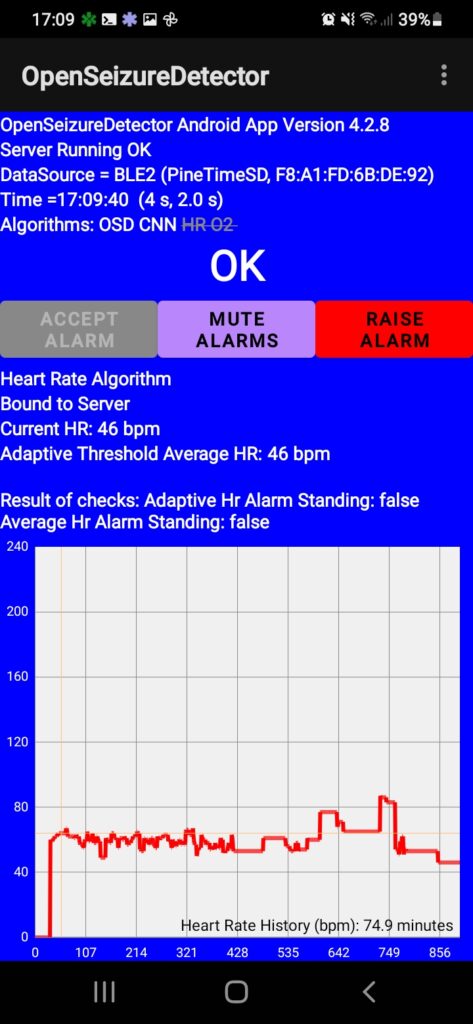
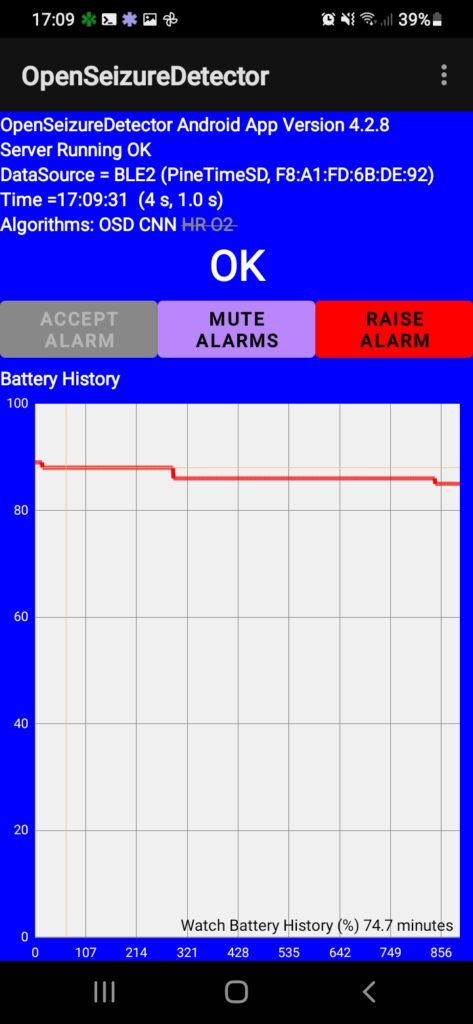
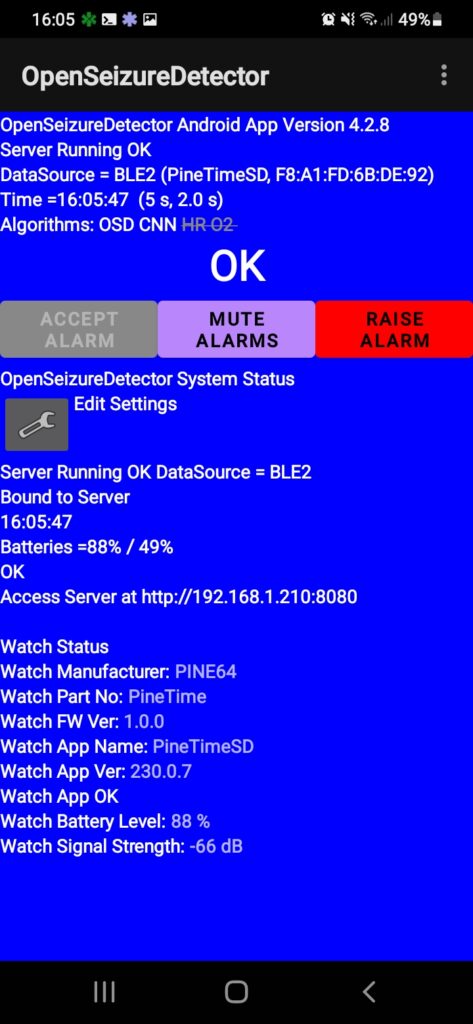
  • Made the main screen swipeable to display different information, such as watch signal strength and battery history graphs (some of this information is only available for PineTime watches). Thanks to Bram Regtien for his contributions.

Thanks too to all of the users who have been acting as Beta testers for this app over the last few months and reporting the issues they have encountered with it.

I have been testing this version for a few months and last week we switched our ‘production’ installation across to using V4.2.8 of the Android app with a PineTime watch for the data source.

I will do some updates to the main Web site over the next few days to reflect PineTime support I’m addition to Garmin.

If you have any problems, please raise an issue on our bug tracker or email graham@openseizuredetector.org.uk. If you have a major issue and need to downgrade to the earlier version, it can be found on the source code repository.

Thanks!

Graham (graham@openseizuredetector.org.uk)

Release of Open Seizure Database V1.4

Version 1.4 of the Open Seizure Database is now available for researchers to use to develop seizure detection algorithms.

Thank you to all of the OpenSeizureDetector users who have contributed data using our Data Sharing system in the OpenSeizureDetector app – we now have data for 194 seizures in the database.

If you haven’t done so already, please will users consider signing up to the Data Sharing (the Open Seizure Database) system and mark events as either real seizures or false alarms. For real seizures please will you also include a few words on what happened to help researchers interpret the data.

Thanks again to every one who has contributed. If you would like access to the database for your research purposes, please check that you are happy to comply with our licence, and email osdb@openseizuredetector.org.uk.

Graham (graham@openseizuredetector.org.uk)